 Daily Race C
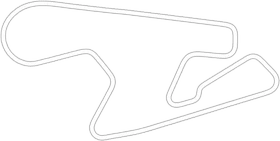

M_McKindley shared this lap together with the replay. By the driver's own account it isn't M_McKindley's fastest lap, and that's fine: it shows the driving style clearly, which is what an analysis needs. Digit put the 1:17.830 against Digit's own best lap from the same Daily Race, a 1:16.321 in the same car on the same tyres, and went through it corner by corner in Traces.
Both laps were recorded live, not from a replay, so the brake points in both are where the pedal really went down and need no correction. Every number below comes from Traces: the Coach, or the telemetry of the two laps measured at the same point on the track. Distances are metres from the start line, measured along the reference lap.
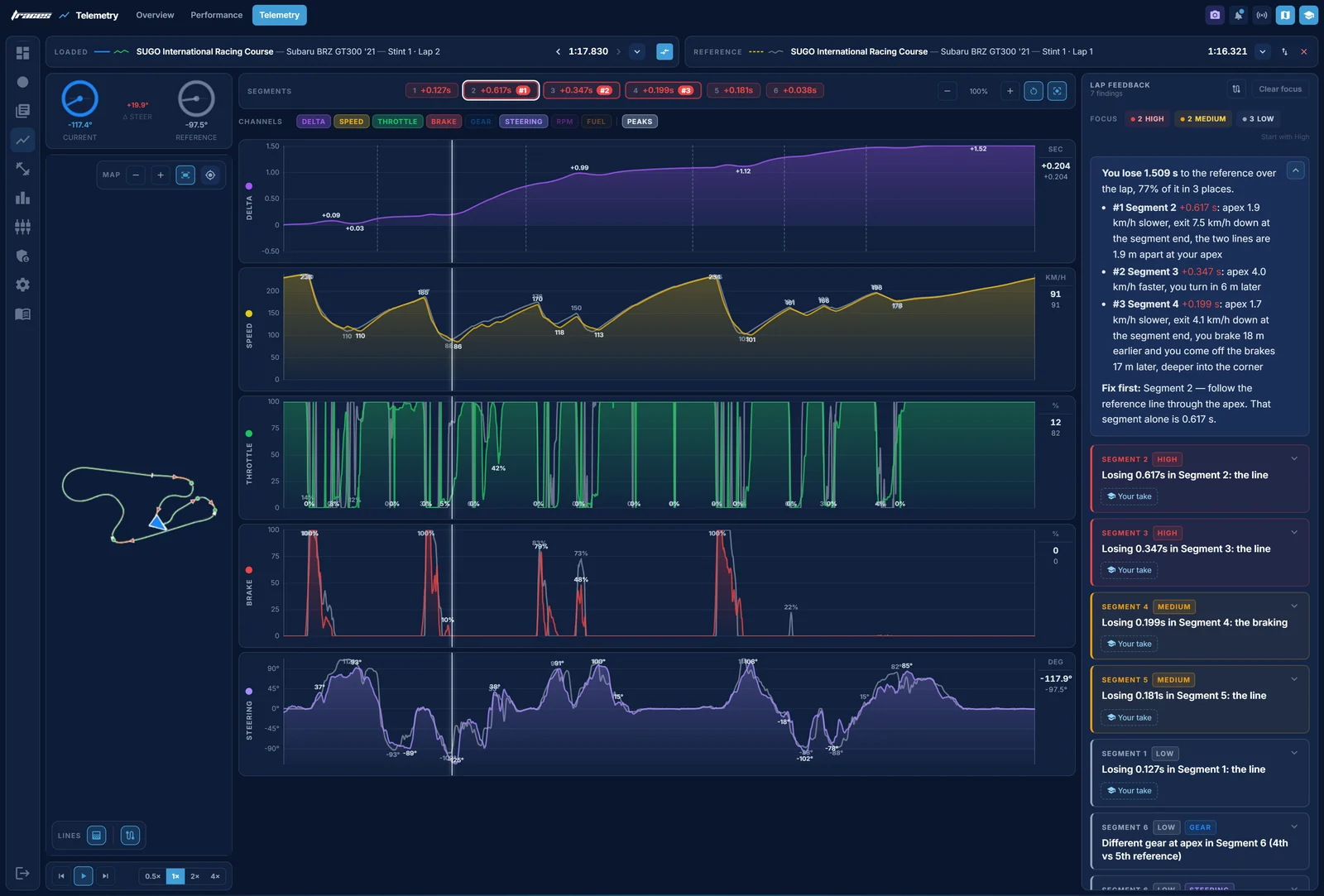
The summary
M_McKindley loses 1.509 s over the lap. The Coach puts 77% of it in three places:
- Segment 2, +0.617 s: apex 1.9 km/h slower, exit 7.5 km/h down at the segment end, the two lines are 1.9 m apart at M_McKindley's apex.
- Segment 3, +0.347 s: apex 4.0 km/h faster, M_McKindley turns in 6 m later.
- Segment 4, +0.199 s: apex 1.7 km/h slower, exit 4.1 km/h down at the segment end, M_McKindley brakes 18 m earlier and comes off the brakes 17 m later, deeper into the corner.
Fix first: Segment 2, follow the reference line through the apex. That segment alone is 0.617 s.
Going corner by corner, three corners hold 0.843 s of it: turn 3 (0.353 s), turn 4 (0.251 s) and turn 2 (0.239 s). Turns 3 and 4 alone are 0.604 s, so there is more than half a second in two corners.
The one thing to fix first: in turn 2, arrive slower, hit the apex, and be back on full throttle by it. That sets up the whole of Segment 2, because turn 3 is taken flat out and everything lost leaving turn 2 is carried all the way to 1,030 m.
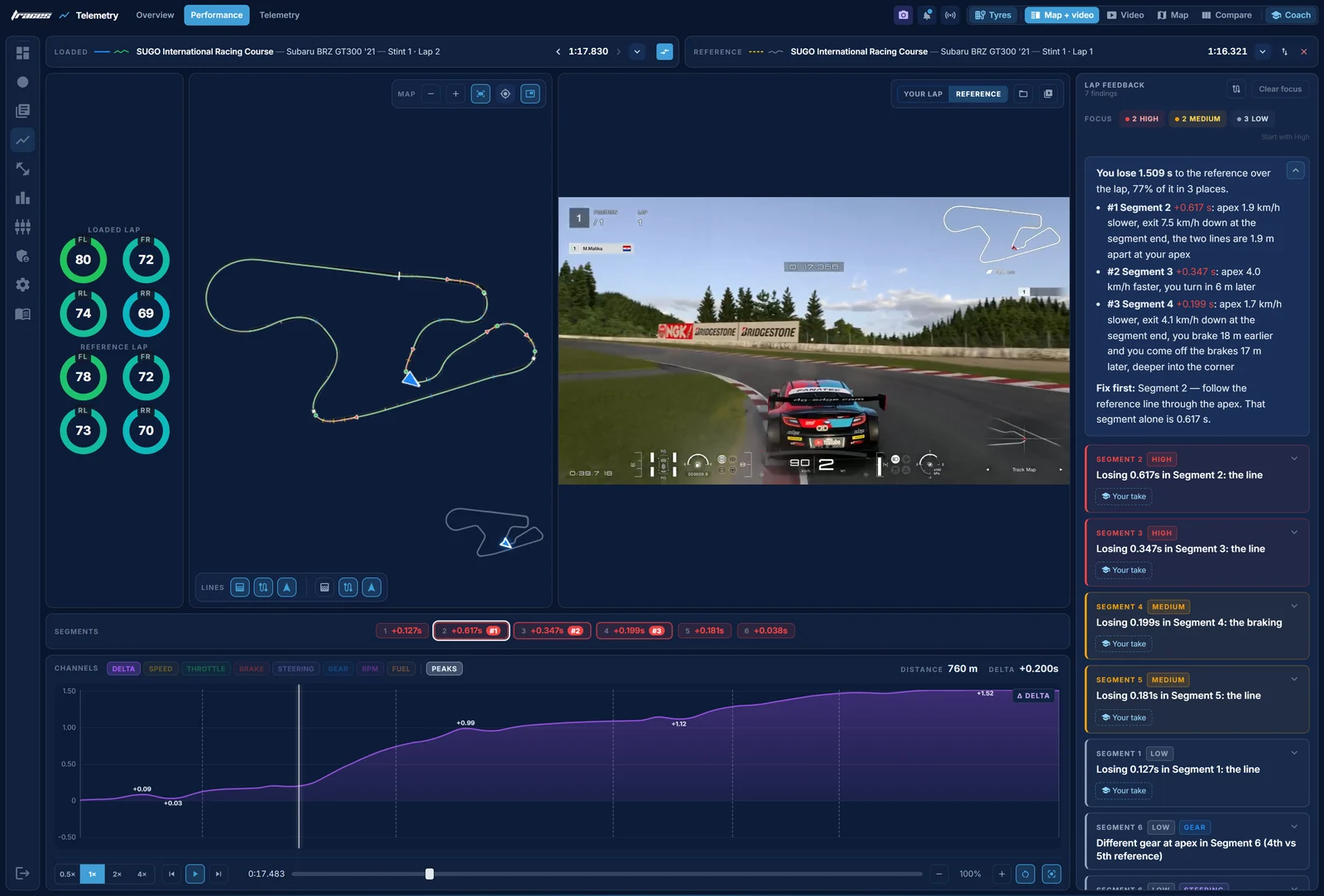
The habit behind most of it
Before going corner by corner, it helps to see the pattern, because it repeats. In five corners M_McKindley is faster than Digit on the way in. That speed doesn't make it to the exit: the car can't turn as tightly, so the slowest point comes 19 to 39 m after the reference apex, the line runs wide, and full throttle comes later. In turn 2 and turn 5 M_McKindley holds a little throttle through that stretch, in turn 4 a little brake. Either way, the car is not turning or accelerating, it is just running wide.
| Corner | 20 m before the reference apex | M_McKindley's slowest point | Full throttle |
|---|---|---|---|
| Turn 1 | 117.8 vs 116.2 km/h | 378 m vs Digit's 339 m | 51 m later |
| Turn 2 | 103.0 vs 96.9 km/h | 775 m vs Digit's 753 m | 14 m later |
| Turn 4 | 136.4 vs 133.6 km/h | 1,162 m vs Digit's 1,143 m | 12 m later |
| Turn 5 | 121.3 vs 114.0 km/h | 1,304 m vs Digit's 1,283 m | 21 m later |
| Turn 6 | 118.0 vs 107.1 km/h | 2,071 m vs Digit's 2,052 m | 22 m later |
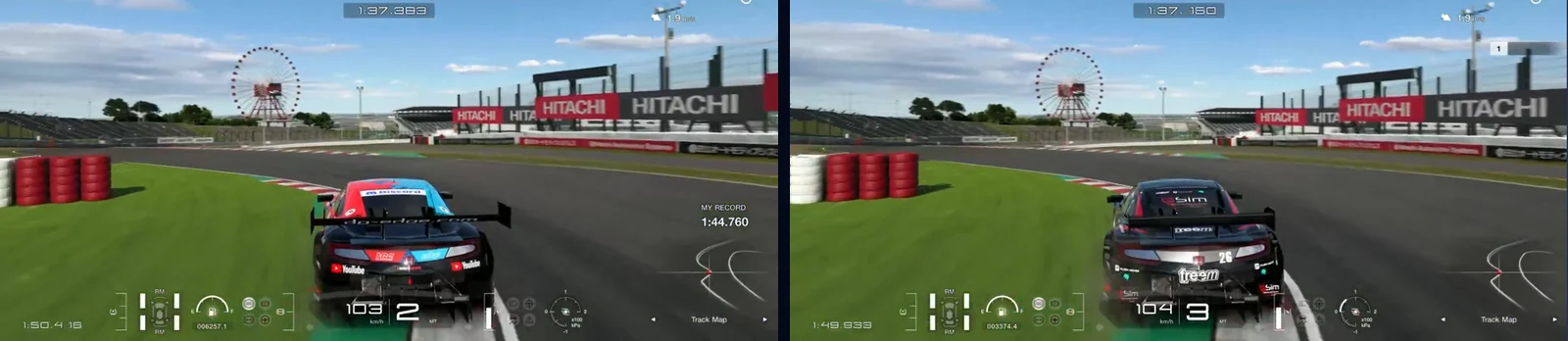
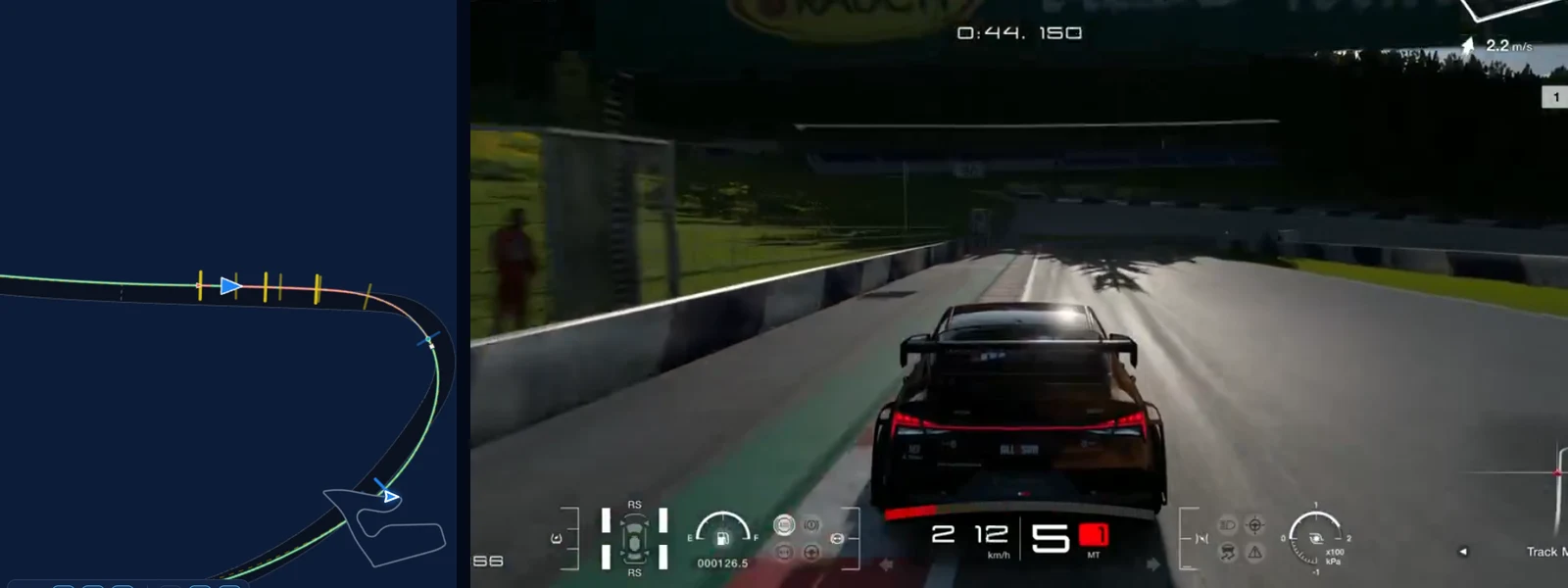
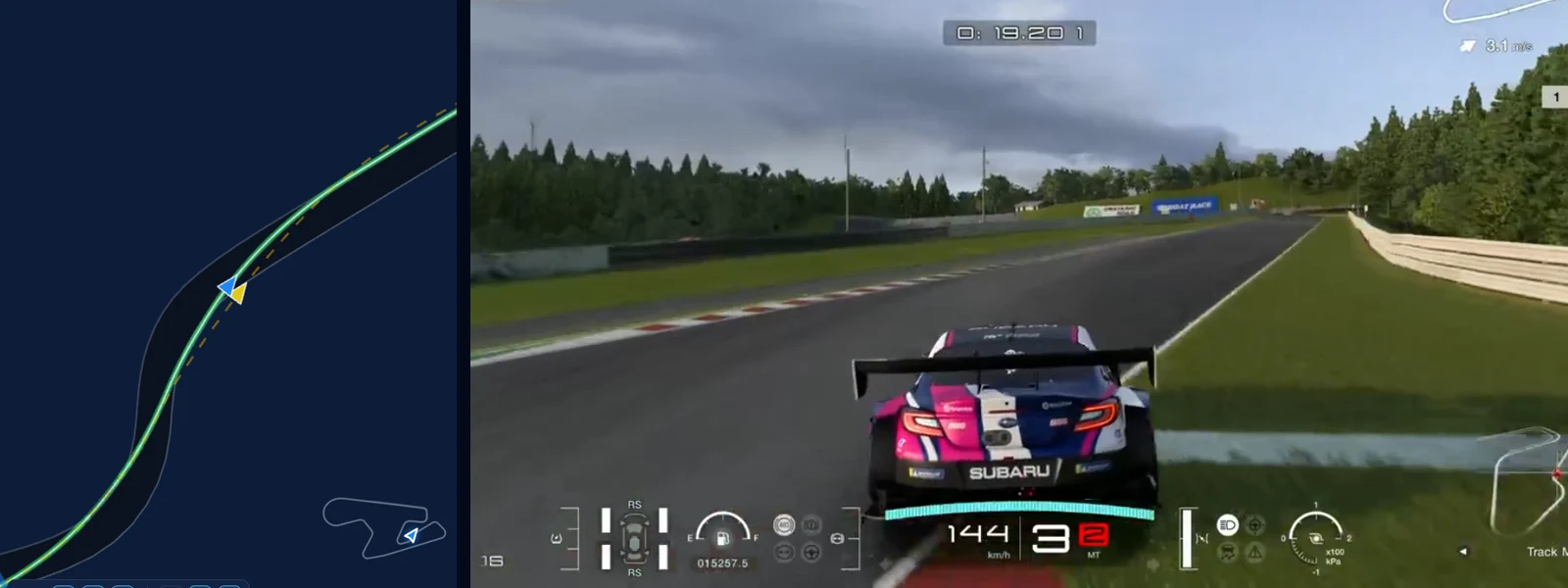
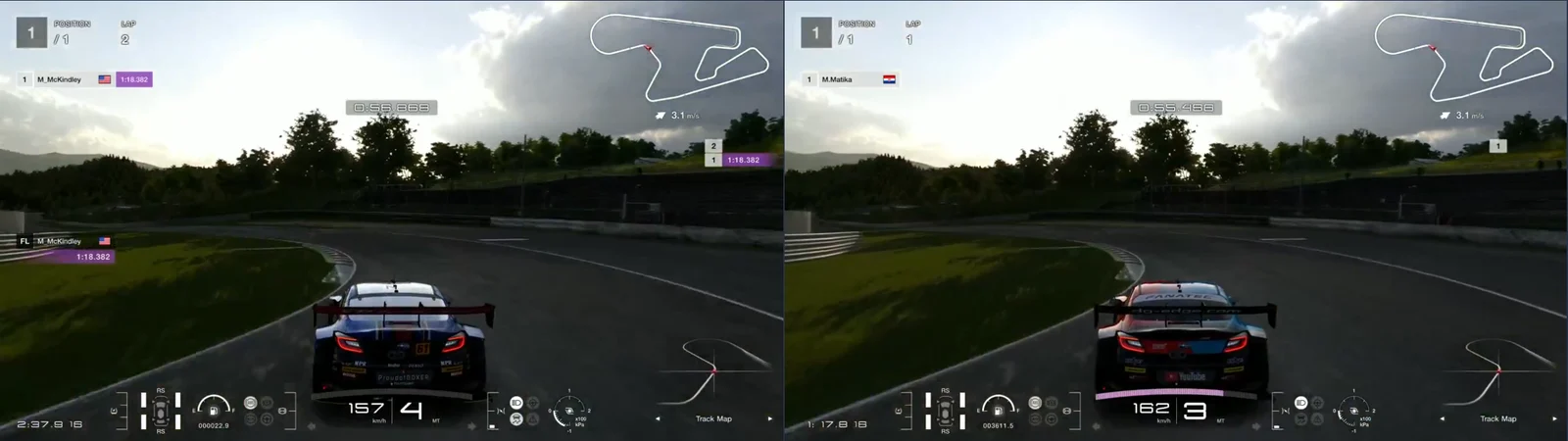
Each picture below has three parts. The first is the Performance page with the map zoomed in on the corner: M_McKindley's line in green, the reference line dashed in yellow, and Digit's video at the same metre. The second puts the two replays side by side at the same point on the track. The third is the Telemetry page zoomed to the corner, M_McKindley's lap in colour and the reference in grey.
Turn 1: the right-hander at the end of the main straight 0.149 s
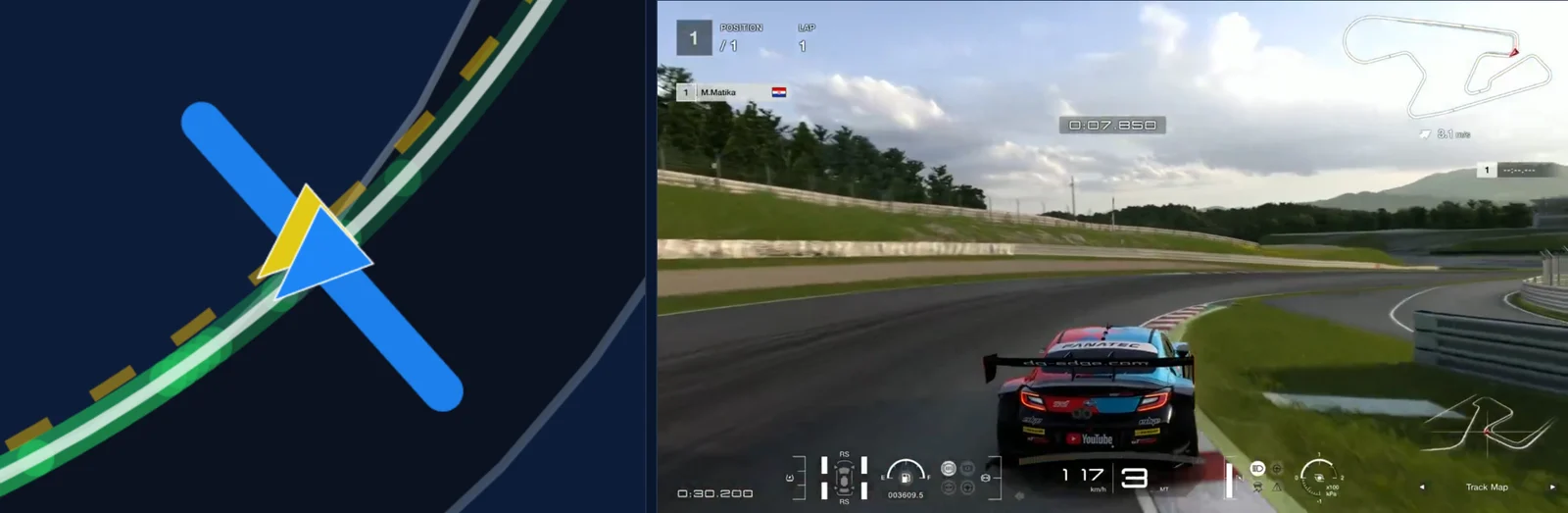
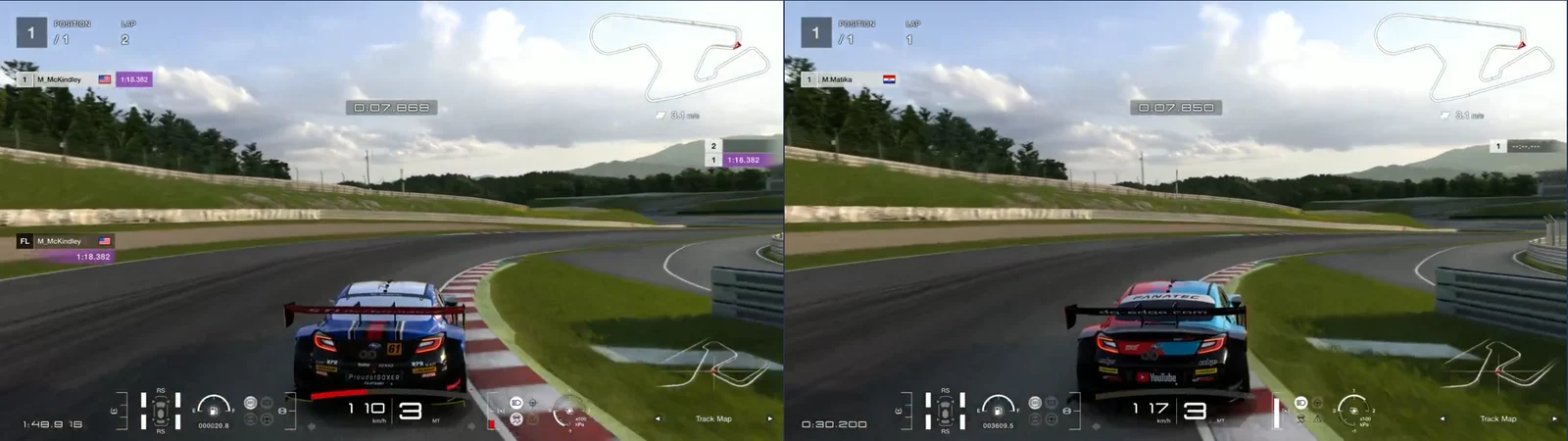
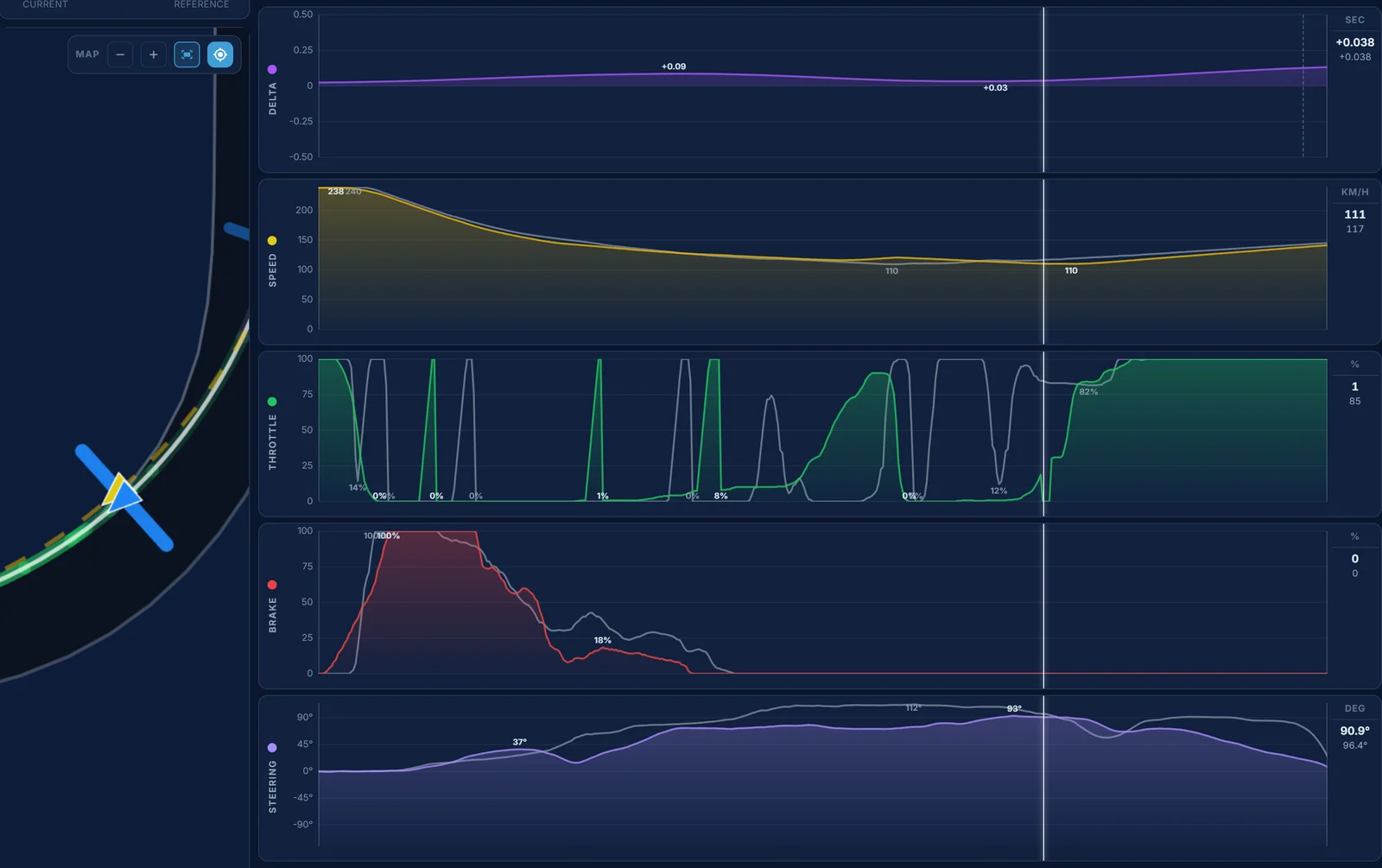
Here M_McKindley even gets ahead of the reference for a moment. The braking comes 14 m earlier, at 154 m against Digit's 168 m, but M_McKindley goes through the middle of the corner much faster: 120.4 km/h at the reference apex, against Digit's 109.6. By 360 m M_McKindley is 0.005 s up.
Then the same thing happens again. The car can't hold that speed, so from 344 m to 376 m M_McKindley's throttle is at 0 to 19%, the line runs 1.0 m wide, and the speed falls to 110.3 km/h at 378 m, in third gear, where Digit took the apex in second. M_McKindley is back on full throttle at 390 m. Digit is there at 339 m. M_McKindley leaves at the same speed, 162.1 against 161.7 km/h at 520 m, but 0.16 s down.
What to change: give up some of that mid-corner speed so the car is pointed at the exit by the apex, and go to full throttle from there.
Turn 2: the second-gear left 0.239 s
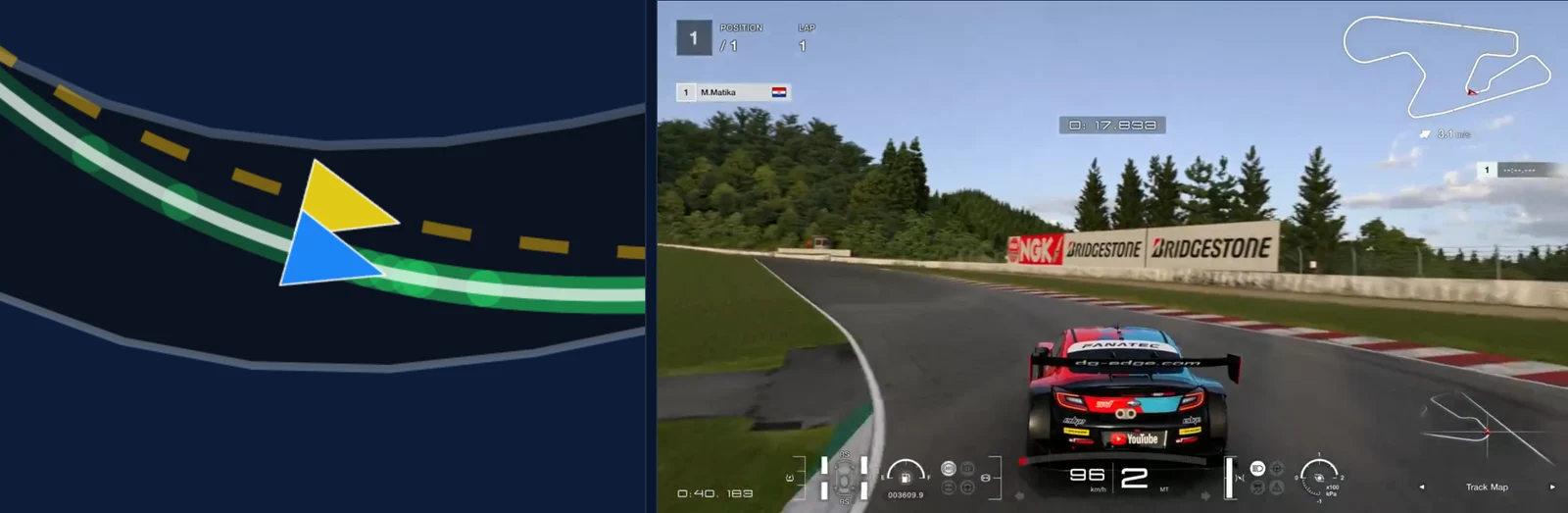
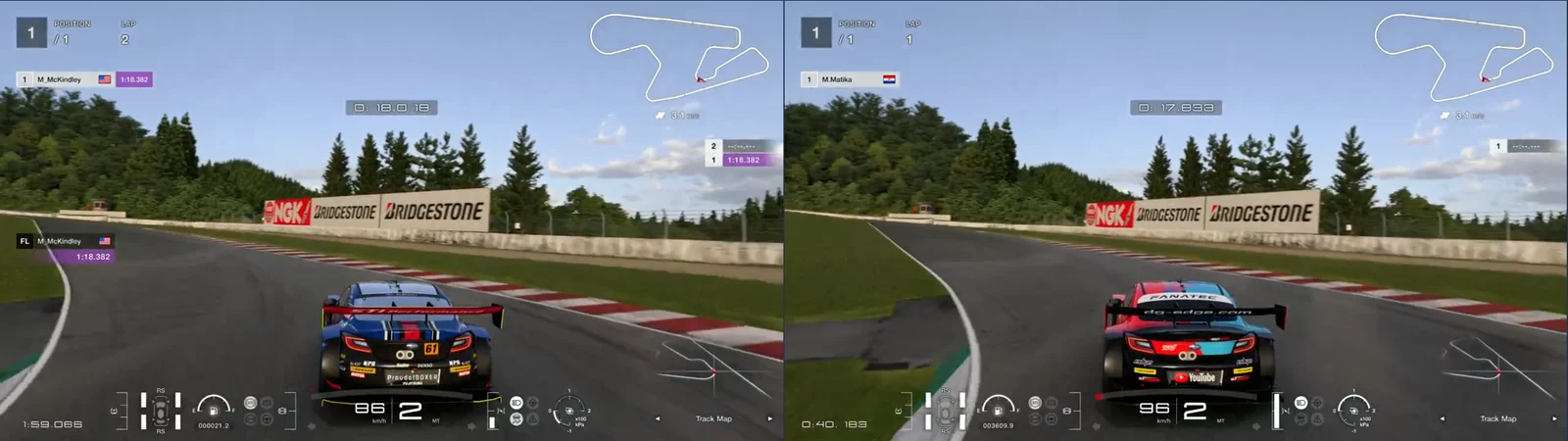
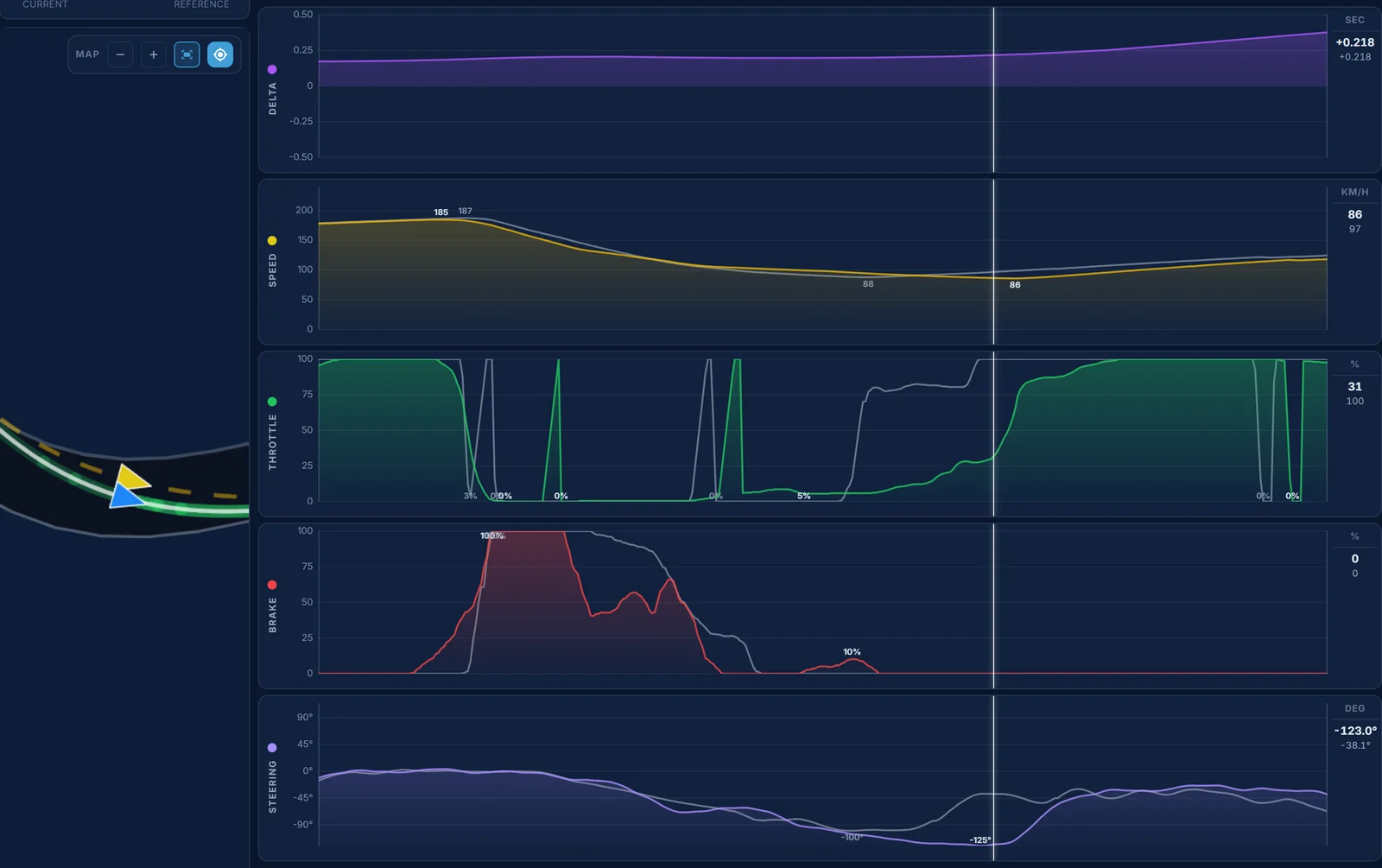
This is the slowest corner on the lap, and the same pattern that comes back at turn 4. M_McKindley brakes earlier, at 649 m against Digit's 666 m, and is off the brake at 728 m against the reference's 735 m. So M_McKindley comes into the corner faster: 103.0 km/h 20 m before the reference apex, against Digit's 96.9. For a moment that gains time.
Then the car runs out of grip. From 736 m to 772 m M_McKindley holds the throttle at 6 to 32%, and touches the brake again at 751 m, while turning the wheel to 125° where Digit needs 100°. The car doesn't turn any tighter for it: the line runs 1.9 m wide of the reference at 774 m. M_McKindley's slowest point is 85.9 km/h at 775 m, 22 m after the reference apex at 87.8 km/h, and full throttle comes at 783 m against Digit's 769 m. M_McKindley leaves 6.2 km/h down at 830 m, and that is what starts turn 3's loss.
What to change: let the speed come down to about the reference apex speed before turning in, then go straight from the brake to the throttle at the apex, with no part throttle in between.
Turn 3: the bend at 900 m 0.353 s
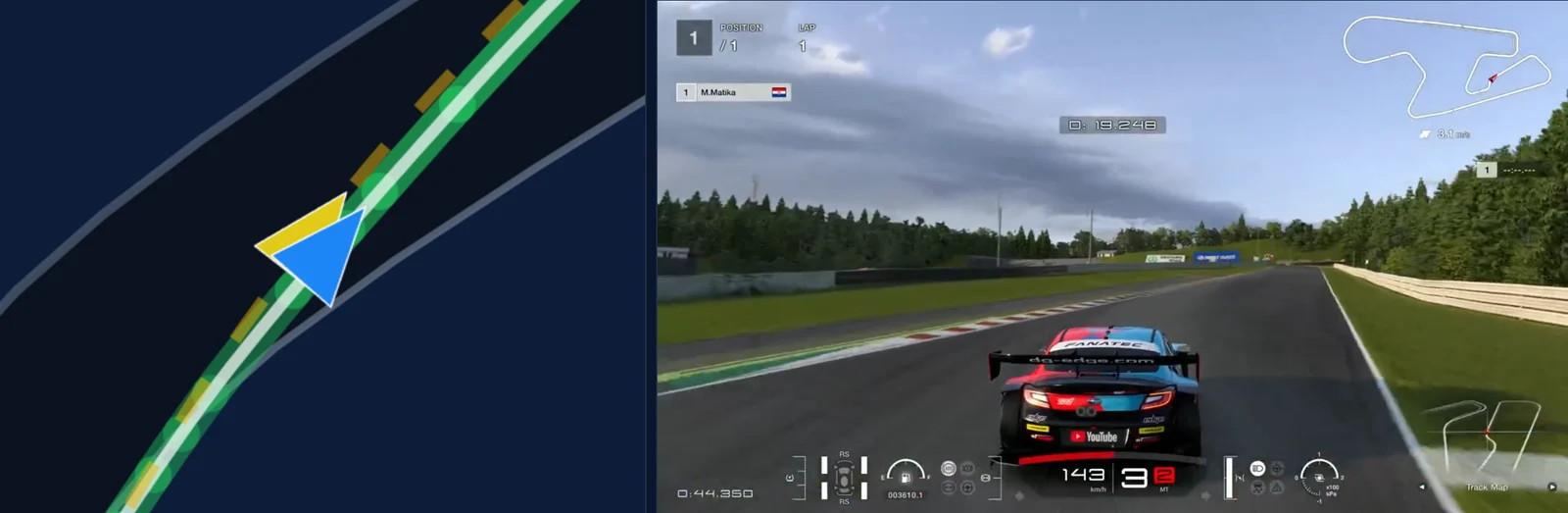
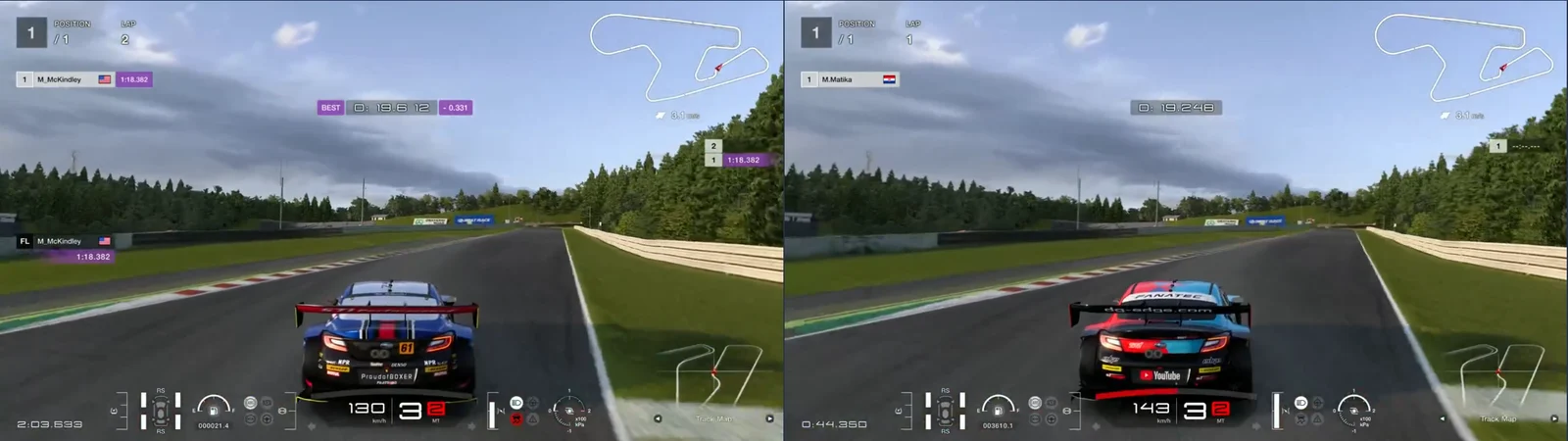
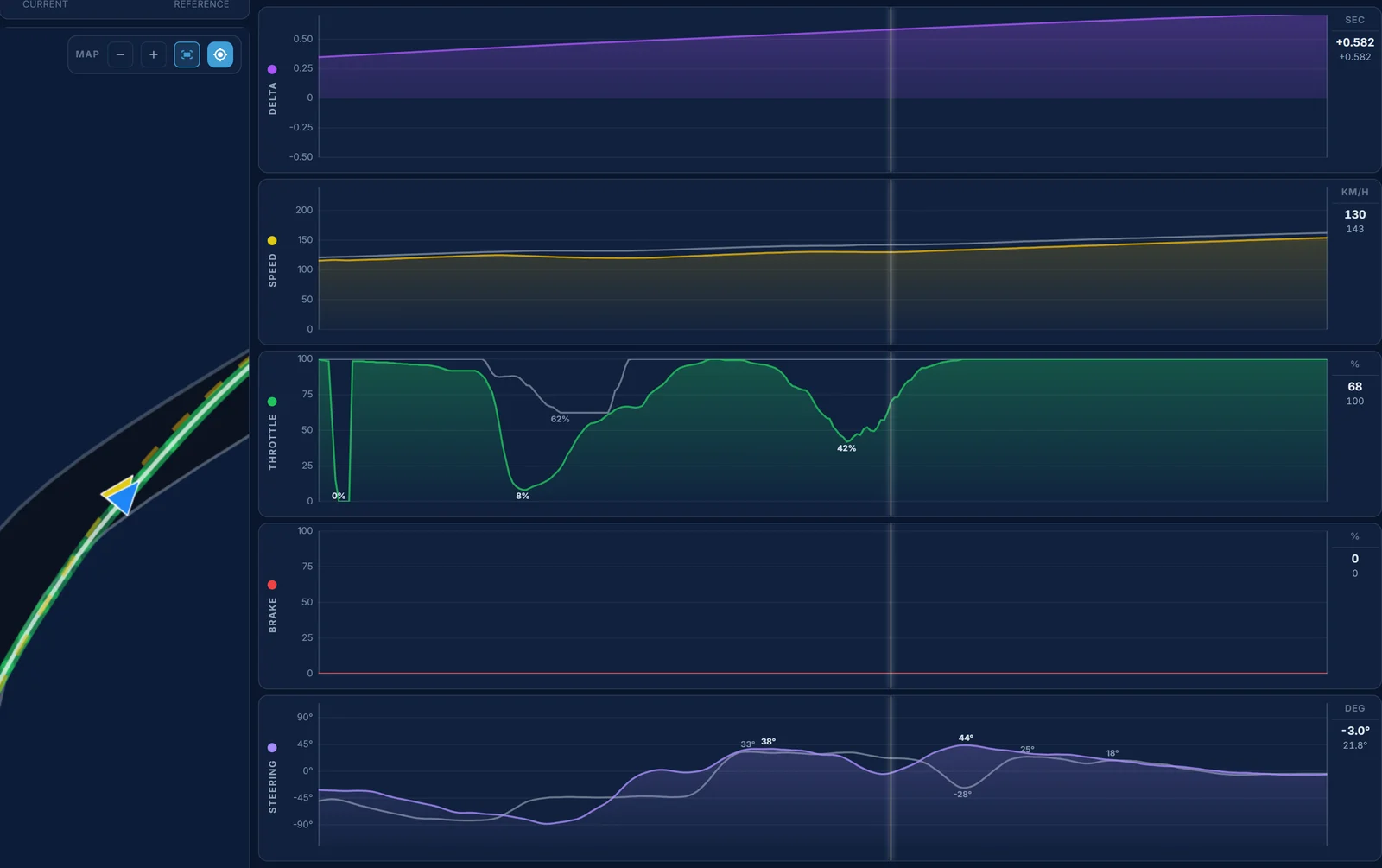
This is the most expensive corner on M_McKindley's lap, and there is no braking in it on either lap. It is a flat-out bend, and the time goes in two ways.
First, M_McKindley arrives slow. At 830 m, coming out of turn 2, M_McKindley is at 117.7 km/h and Digit is at 123.9 km/h. Second, there are two lifts. Between 840 m and 880 m M_McKindley's throttle drops to 8%, where the reference only dips to 62%. Then, between 895 m and 925 m, it drops again to 42% while Digit is at 100%. Into turn 3 the car goes too far to the right: up to 0.9 m right of the reference line at 922 m, on the inside. That part of the track is dirty, and the two lifts through it cost speed all the way down to turn 4.
What to change: stay out of the dirty inside, on the reference line, and keep the throttle flat from 875 m all the way to the braking for turn 4.
Turn 4: the right-hander at 1,143 m 0.251 s
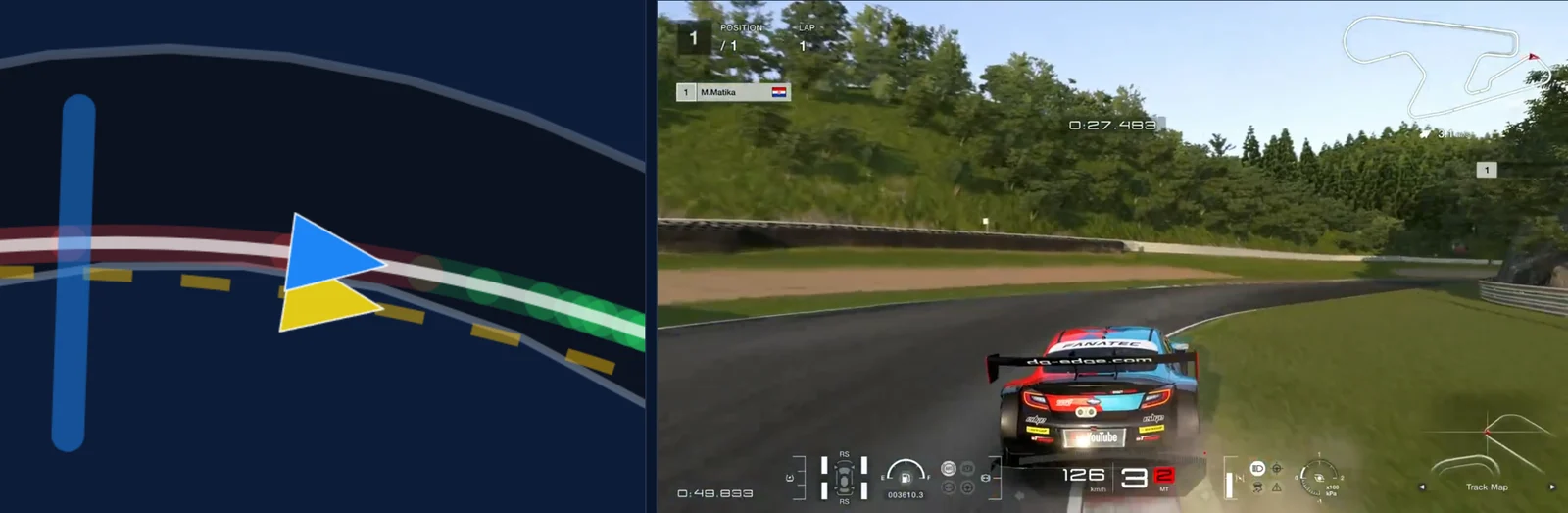
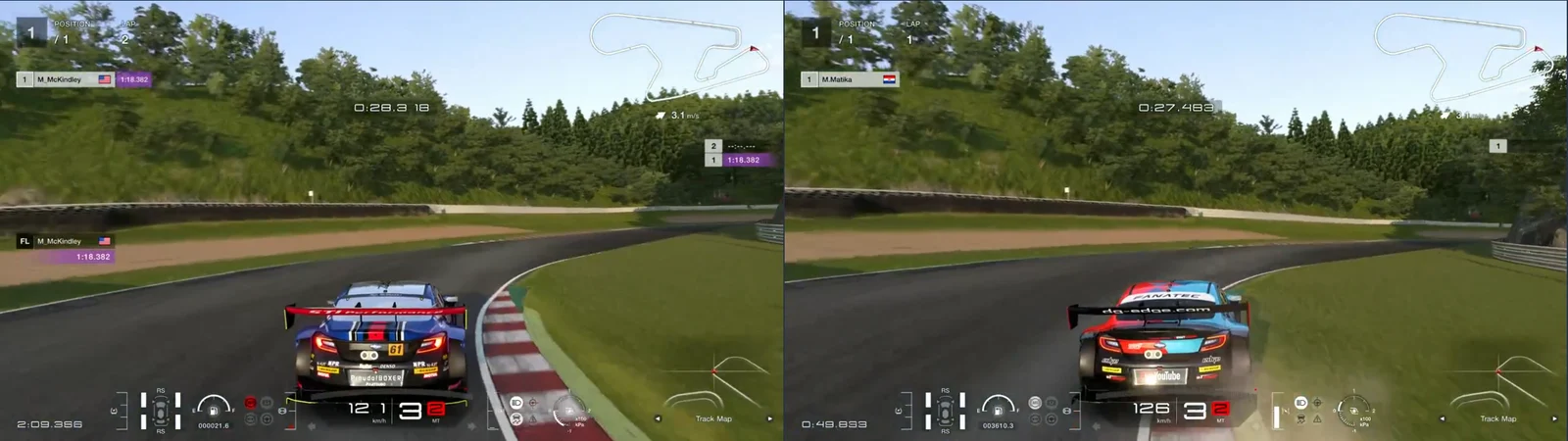
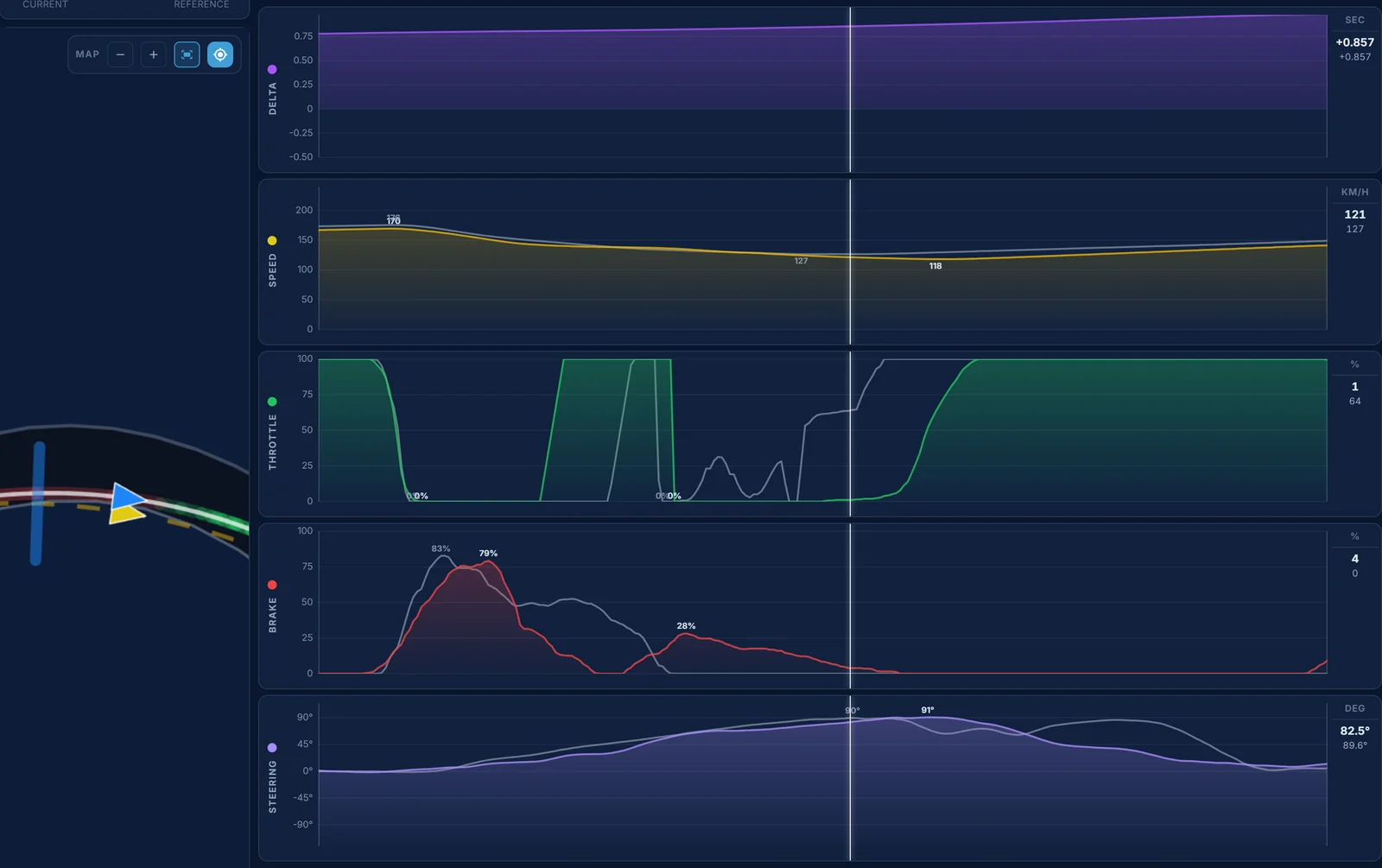
The braking starts in the right place: M_McKindley's first touch is at 1,070 m and Digit's at 1,073 m. The problem is what comes after. M_McKindley carries more speed into the corner: 20 m before the reference apex the speed is 136.4 km/h against Digit's 133.6. To make the corner at that speed M_McKindley goes back on the brake and stays on it. The reference brake is off at 1,123 m. M_McKindley's is still on at 1,157 m, 34 m later, at 28% easing down to 4% between 1,125 m and 1,150 m, and still 12% after the reference apex.
Braking that late, with the wheel turned, the front tyres have to slow the car and turn it at once, so the car understeers. It misses the apex, 1.2 m wide of the reference line, and runs out to 1.6 m wide at 1,158 m. The speed keeps falling past the apex, from 124.7 km/h at the reference apex to 118.2 km/h at 1,162 m, while Digit is already accelerating from 126.5 km/h. Full throttle comes at 1,166 m against Digit's 1,154 m, and M_McKindley leaves the corner 6.2 km/h down.
What to change: brake at the same point, but get the car slowed before turning in, so the brake is off by about 1,123 m, the car is at the apex at 1,143 m, and the throttle goes back on from there.
Turn 5: the right-hander at 1,283 m 0.087 s
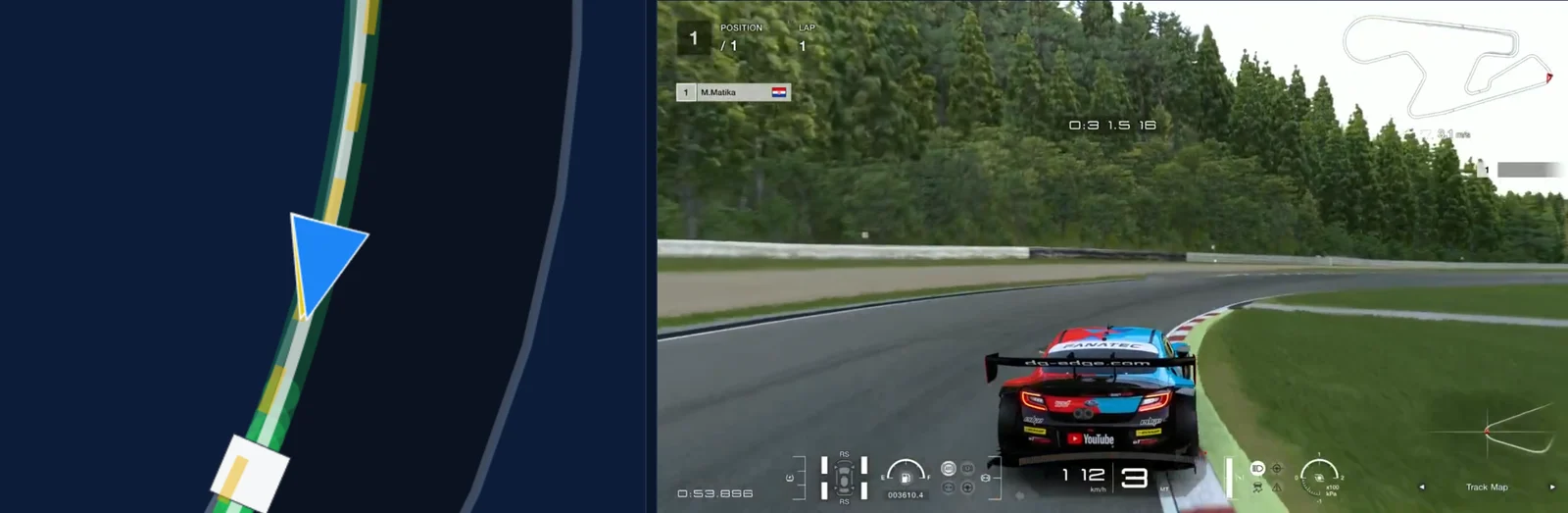
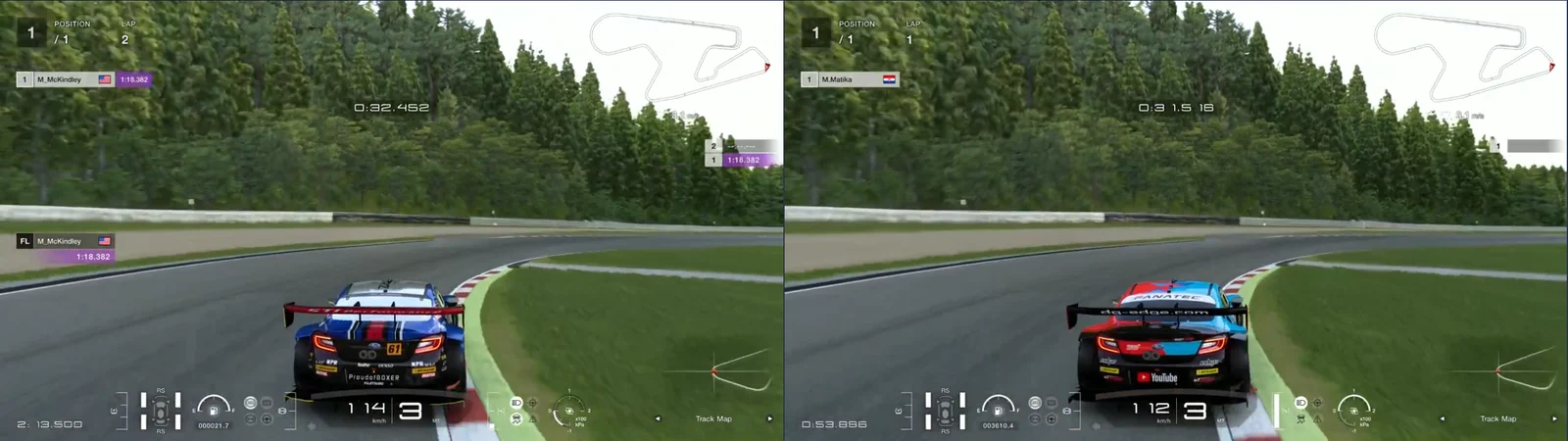
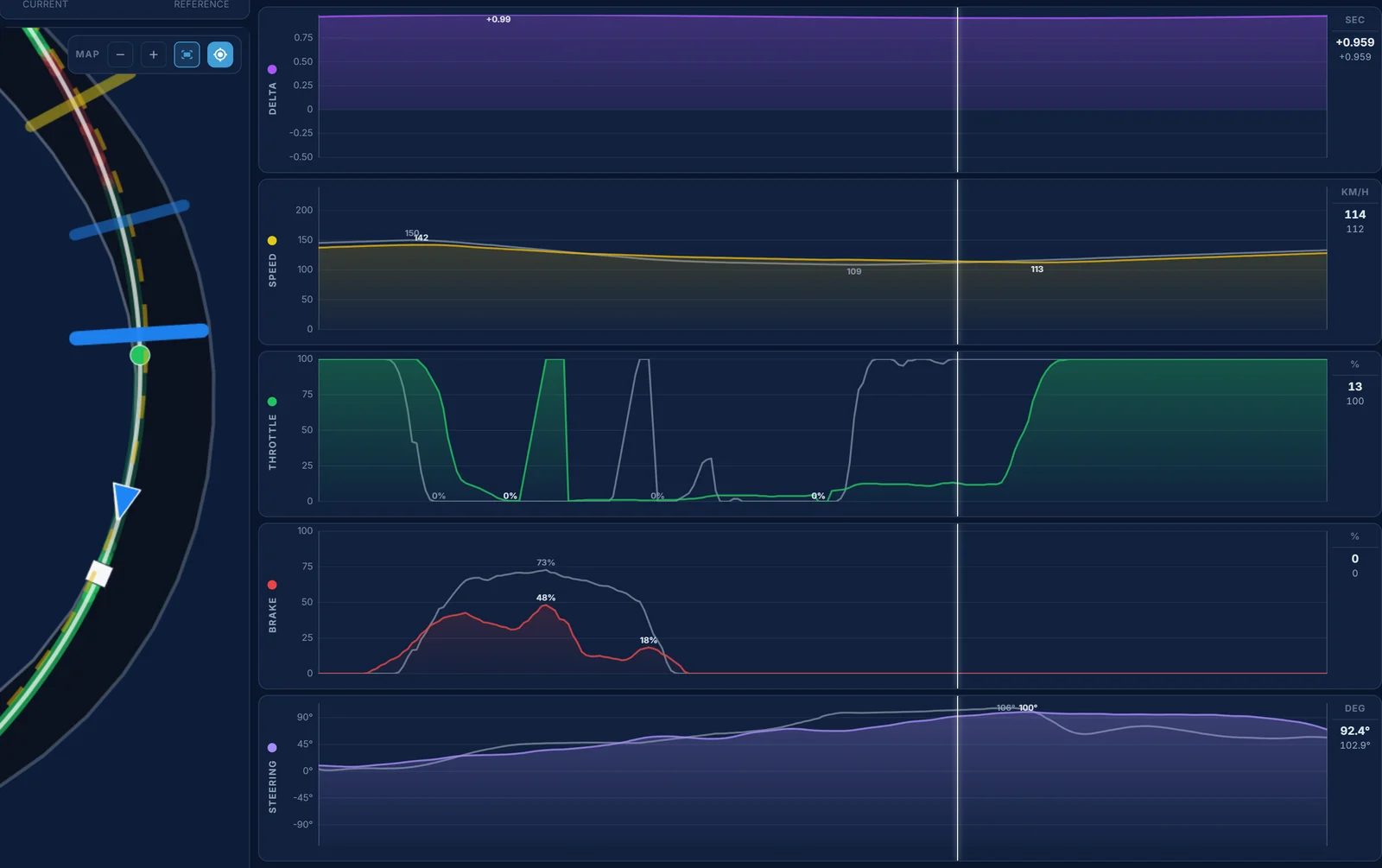
Turn 5 is the clearest example of the trade. M_McKindley's brake point is 5 m before Digit's, at 1,217 m against 1,222 m, but the braking is lighter, peaking at 48% against the reference's 73%, and the car arrives faster: 117.1 km/h at the reference apex against Digit's 108.7. That gains M_McKindley 0.08 s by 1,295 m. Then M_McKindley holds 0 to 13% throttle from 1,267 m to 1,300 m, the speed falls to 112.6 km/h at 1,304 m, the line runs up to 0.9 m wide, and full throttle comes at 1,305 m against Digit's 1,284 m. Down the long run that follows, the slower exit costs more than the entry gained.
What to change: brake as hard as the reference does and accept the slower apex. The long straight after it pays for a good exit, not a fast entry.
Turn 6: the big stop 0.215 s
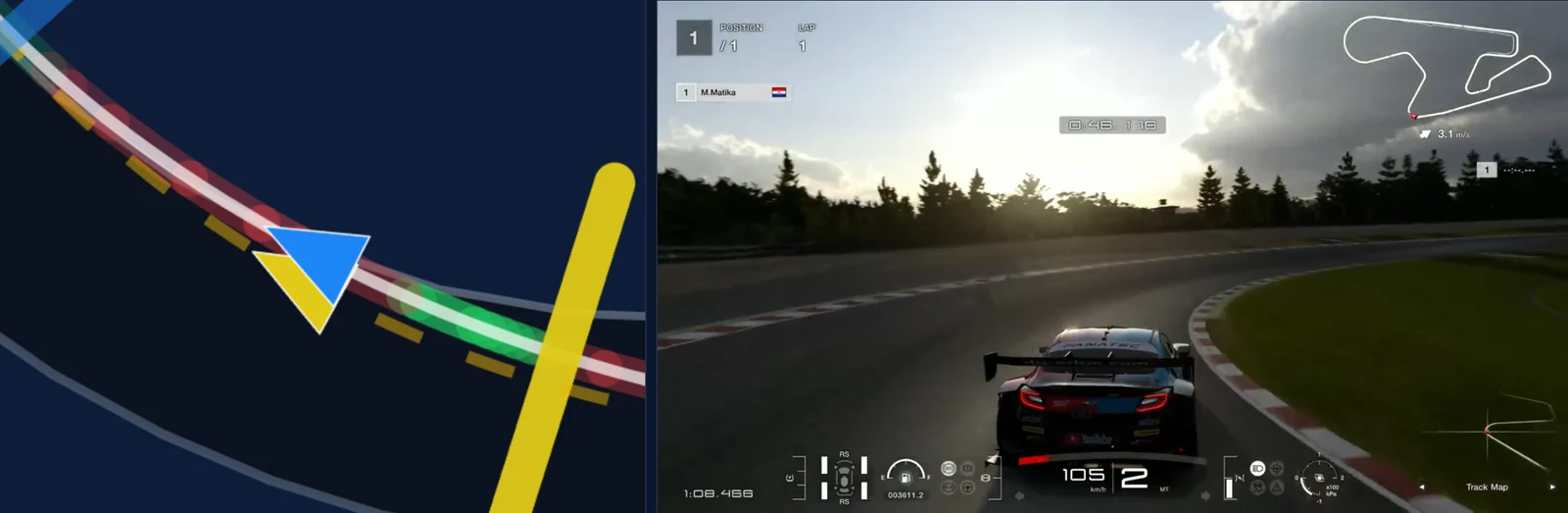
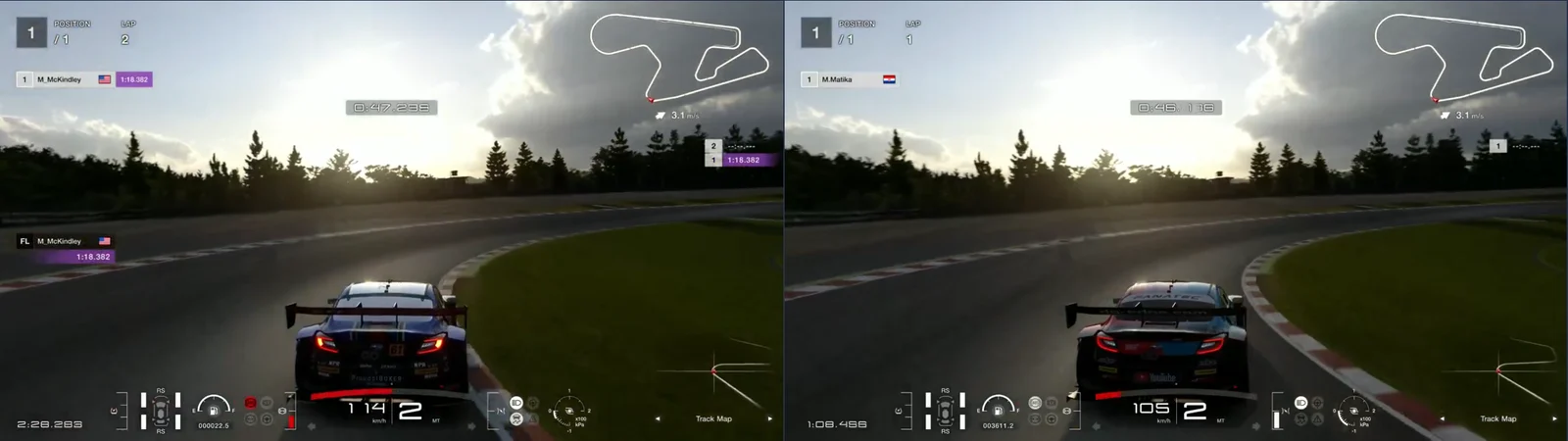
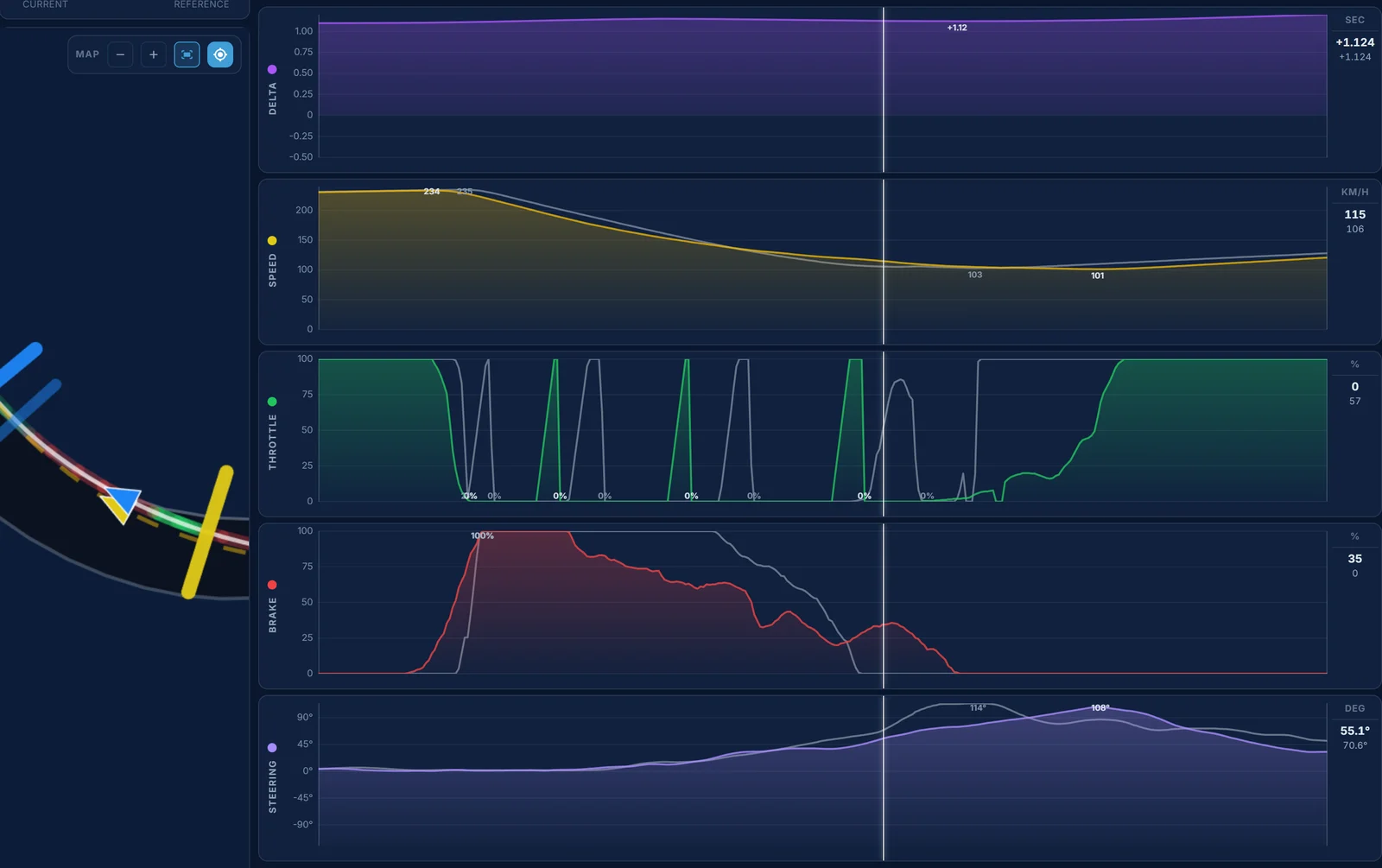
The hardest stop on the lap, from over 230 km/h. M_McKindley brakes 19 m before Digit, at 1,912 m against 1,931 m, and comes off the brake 17 m later, at 2,049 m against 2,032 m. Between the reference release and the reference apex M_McKindley still has up to 36% brake on. Again M_McKindley carries more speed in: 118.0 km/h 20 m before the reference apex, against Digit's 107.1. M_McKindley's slowest point is 101.4 km/h at 2,071 m, 19 m after the reference lap's at 103.1 km/h, and full throttle comes at 2,074 m against Digit's 2,052 m. The exit speeds end up close, 159.5 against 160.3 km/h at 2,230 m, but the late throttle has cost the time by then.
What to change: brake later, and finish the braking before the corner instead of trailing it to the apex.
Turns 7 and 8: the left-hander and the kink 0.170 s
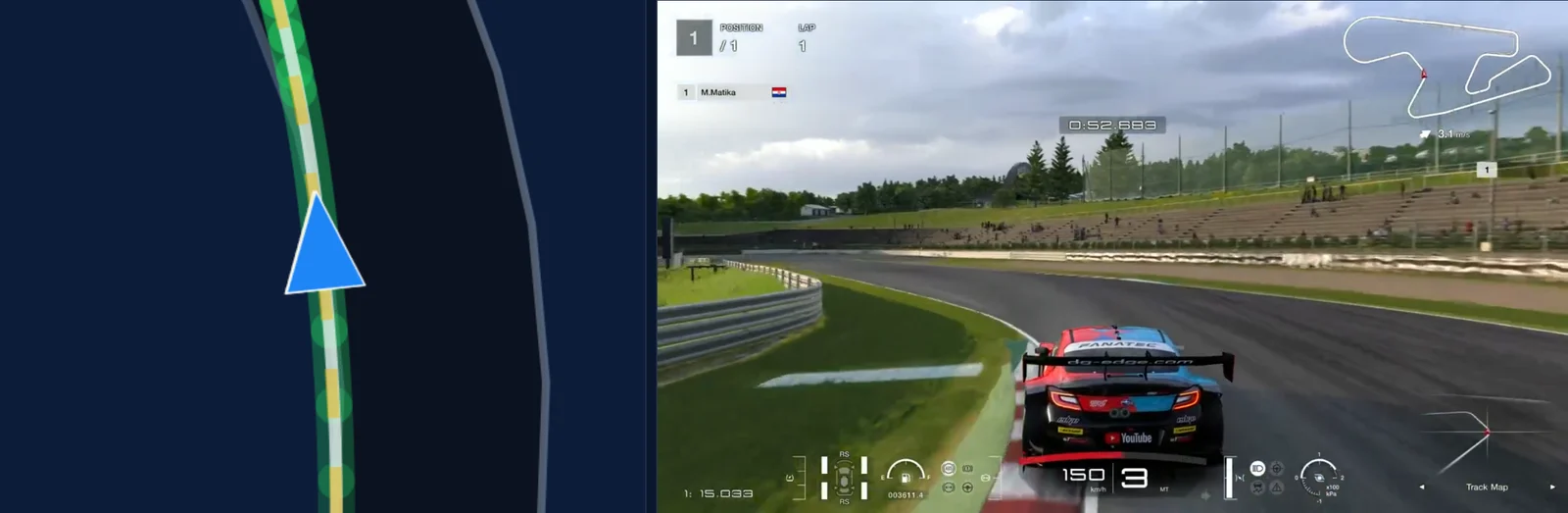
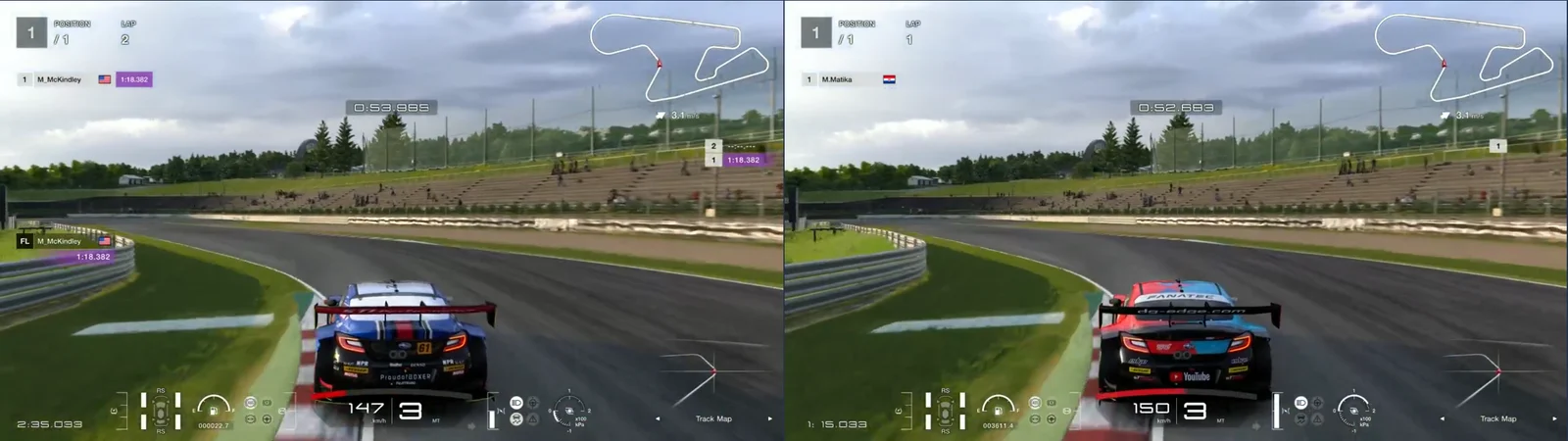
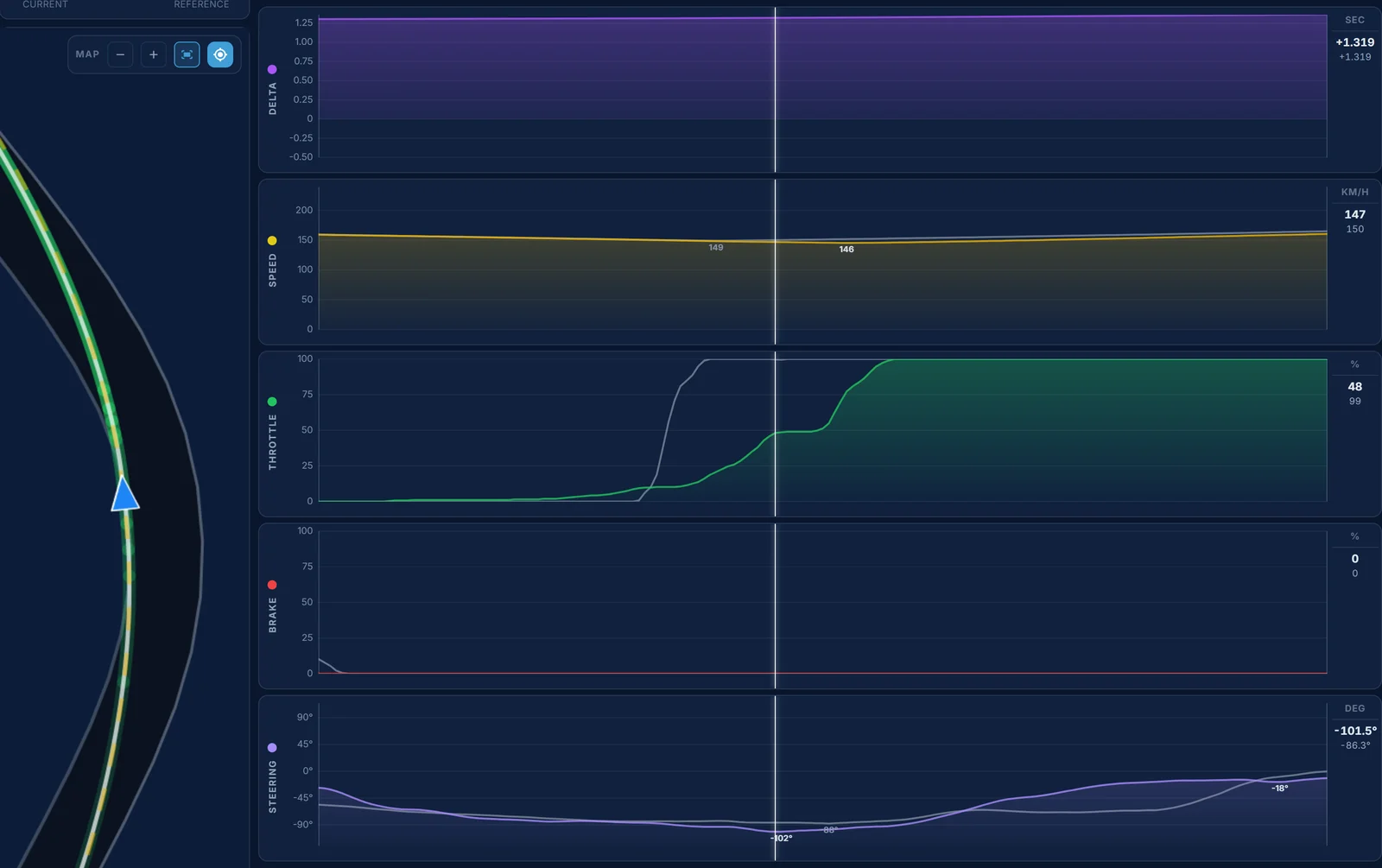
Two quick lifts, no brake on either lap, and the lines are within 0.1 m of each other at both apexes. M_McKindley arrives at turn 7 at the same speed as Digit, 153.3 against 153.5 km/h 20 m before the apex, so the entry is good. The time goes because the throttle comes back later. In turn 7 M_McKindley is at full throttle at 2,296 m and Digit at 2,278 m, and M_McKindley carries 145.5 km/h through the apex against the reference's 149.2. In the kink M_McKindley stays off the throttle longer: back to full at 2,445 m against Digit's 2,429 m, 154.9 against 160.2 km/h through it. M_McKindley also uses more steering through the two corners, up to 102° against Digit's 88°.
What to change: the line is right, so trust it: back to full throttle at the apex of turn 7, and only a short lift for the kink.
Turn 9 to the line 0.047 s
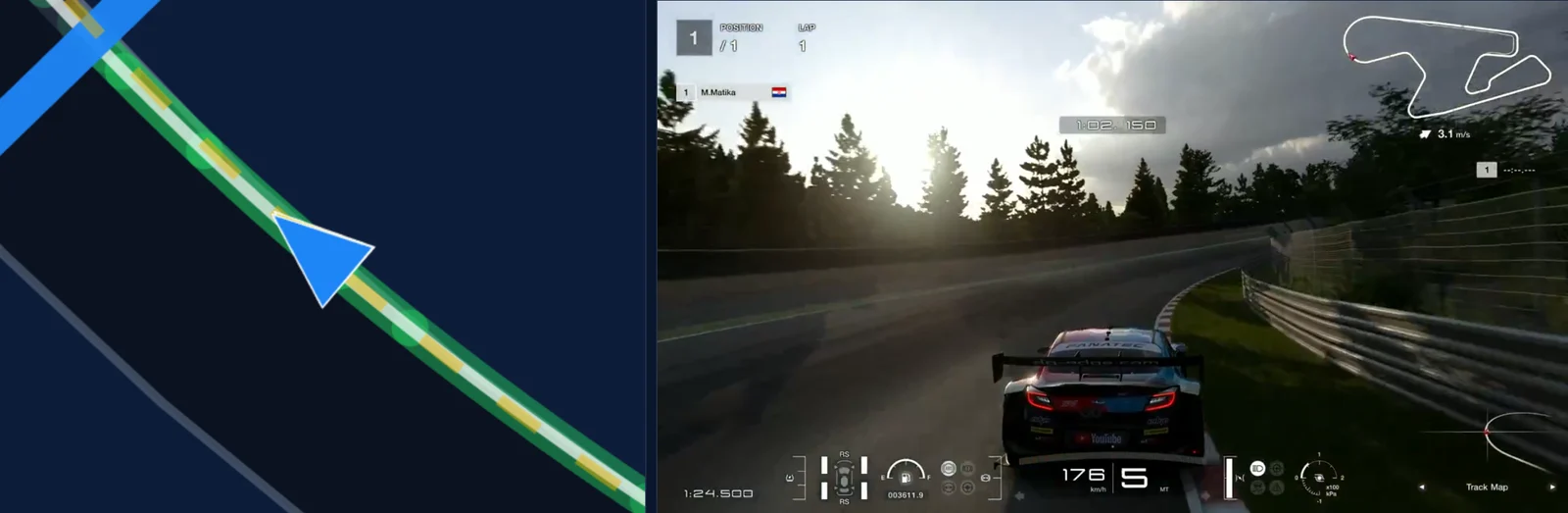
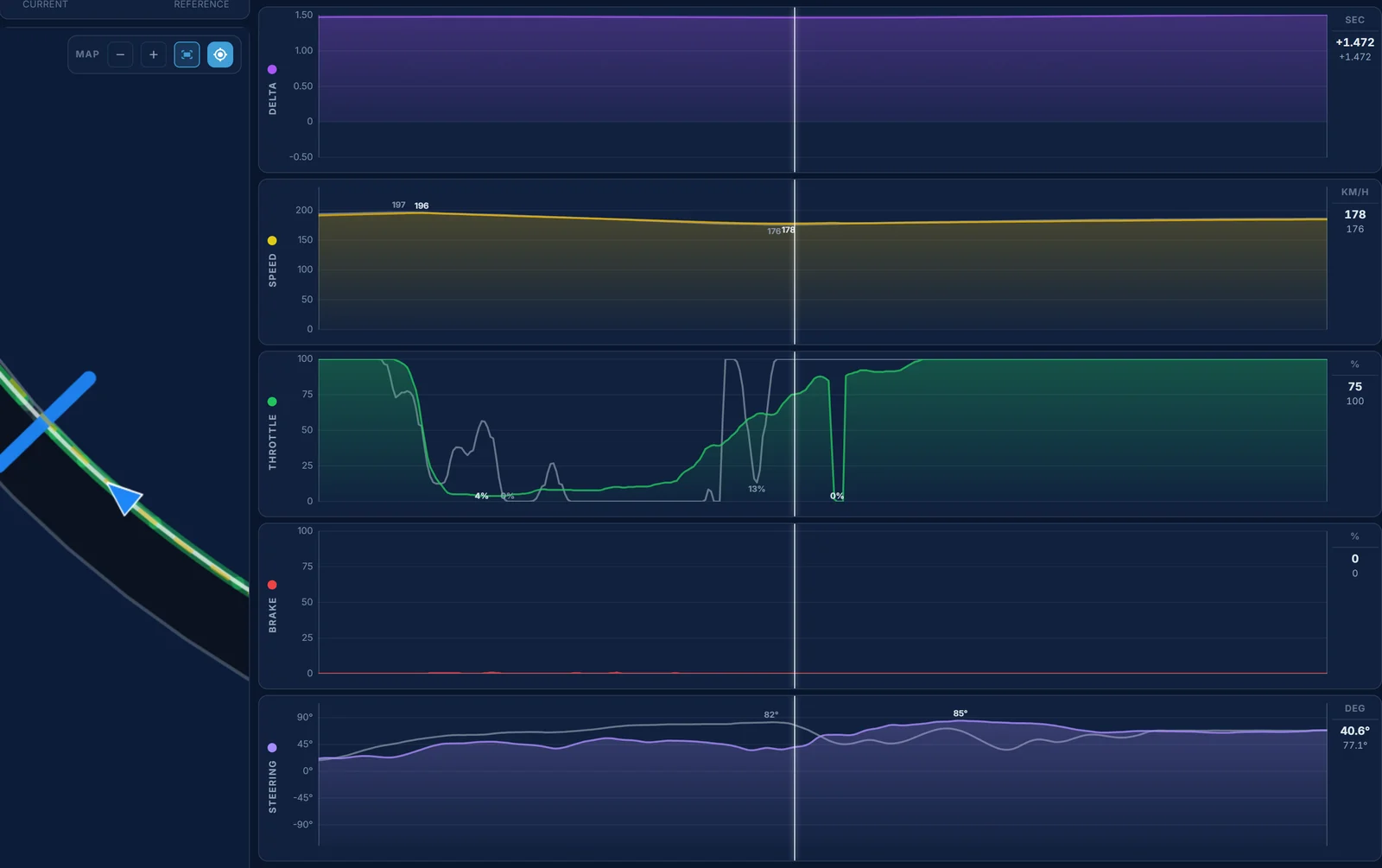
The run to the line is close. There's no brake on either lap, the lines are together, and M_McKindley carries 178.2 km/h through the last fast right-hander against Digit's 176.2. M_McKindley takes it in fourth where the reference lap is in fifth, and the Coach flags that too, with full throttle at 2,762 m against Digit's 2,739 m. M_McKindley crosses the line at the same speed, 229.4 against 229.6 km/h. There's very little to chase here.
What to change: nothing big. Try fifth gear through the last right-hander, as Digit does.
What to practise
The one focus for M_McKindley's next session: full throttle by the apex. Start with turn 2, because it sets up turn 3 and all of Segment 2. Brake a little more, so the car reaches the apex at about the reference speed, and the moment the car is at the apex go straight to full throttle, with no part throttle in between. Then keep it flat through turn 3, away from the dirty inside.
Don't judge it by the speed going into the corner. Judge it in Traces after each run: in turn 2, M_McKindley's full throttle is at 783 m now, and Digit's is at 769 m. When that number comes down and the throttle trace through turn 3 stays at 100%, the same habit will be easy to take to turn 4, turn 1 and turn 5.
Off the track, the Drills in Traces train the same two things with the pedals alone. Brake Release and Brake Ramp Up build the braking that is finished before the apex, the way the reference brakes into turns 4 and 6. Throttle Ramp Up and Throttle Hold build the clean move to full throttle at the apex, with no part throttle in between, that turns 1, 2 and 5 are missing.
What is already good
M_McKindley's braking points are good where it matters. In turn 4 M_McKindley is on the brake 3 m before Digit, and in turn 5 it's 5 m. Carrying speed is no trouble either: M_McKindley went through the middle of turn 1 at 120.4 km/h, against the reference's 109.6, and was briefly ahead there. And the end of the lap is clean: from turn 9 to the line M_McKindley loses only 0.047 s in 930 m. M_McKindley already brakes in the right places and isn't afraid of speed. The job now is to use that speed on the way out of the corner, not the way in.
Measured in Traces: M_McKindley's 1:17.830 (lap 2) against Digit's reference lap, 1:16.321, SUGO International Racing Course, Subaru BRZ GT300 '21, Daily Race C, Week 44/2026. Both laps recorded live. Times lost per corner are the gap between the two laps at the corner's start and end; the Coach's segment times are its own.